Insurance Risks
Providing strategic oversight of insurance risks, including motor, property, and other forms of non-life insurance.
The Insurance Risks Department provides strategic direction on key challenges in the non-life insurance industry.
Its focus areas include crime prevention and road safety in motor insurance, fire and flood risks in property insurance, and infrastructure resilience in light of climate change. It also leads the Agricultural Insurance Project, linking transformation with risk management, and works on systemic risk solutions to support insurance sustainability and close the protection gap. Skills development is a key priority, with efforts to transfer knowledge to a new, diverse generation of insurance professionals.
In addition to risk oversight, the department administers various strategic divisions within SAIA, including the Association of Marine Underwriters in South Africa (AMUSA), the South African Association of Engineering Insurers (SAAEI), and SAIA’s specialist lines committees, also known as Forums.
GOVERNING STRUCTURE
Motor Insurance
Primary Objectives of the Motor Insurance Portfolio
The Motor Insurance portfolio primarily aims to enhance the affordability of comprehensive vehicle insurance, promote road safety initiatives across South Africa, and curb vehicle-related crime.
Key efforts to combat vehicle crime include financial support for Business Against Crime South Africa (BACSA) initiatives and close collaboration with the Insurance Crime Bureau (ICB) to address criminal activities related to motor vehicles.
Portfolio Management and Oversight
The SAIA Motor Insurance Risks portfolio projects are overseen by the SAIA Motor Steering Committee and the Salvage Database Governance Committee and supported by various subcommittees, forums, and task teams.
Industry Impact and Key Initiatives
Under the guidance of the National Road Traffic Act, 1996 (Act No. 93 of 1996), SAIA carries out its mandate through several initiatives:
-
Professionalisation of Vehicle Damage Quantifiers:
SAIA has actively driven the development and recognition of professional qualifications for vehicle damage quantifiers. This includes supporting the establishment of the Vehicle Damage Quantification Board of South Africa (VDQGBSA).
-
Combatting Vehicle Crime:
SAIA demonstrated a strong commitment to fighting vehicle crime-related fraud by playing a key role in establishing the ICB in 2008.
-
Technological Innovations:
In 2004, SAIA contributed to the development of the Automatic Number Plate Recognition (ANPR) technology, which has evolved into the Licence Plate Recognition for South Africa (LPR4SA), currently administered by the Insurance Crime Bureau.
-
Road Safety Advocacy:
Driven by a passion for reducing road traffic accidents and fatalities, SAIA was instrumental in creating the Business for Road Safety Forum, working collaboratively with external stakeholders to promote safer roads.
Key Activities and Committees
Motor Insurance Steering Committee
This committee, which comprises industry experts in motor underwriting, claims, and salvage-related matters, operates as a think tank for motor-related projects.
Salvage Database Governance Committee
Made up of experienced professionals, including motor salvage managers, claims managers, and assessors, this committee provides advisory support to the SAIA Board Committee: Insurance Risks.
Road Safety Committee
This committee consists of claims and underwriting managers who promote road safety-related initiatives in their respective organisations.
Its core mandate is to influence and support the implementation of the National Road Traffic Safety Strategy.

- Licence Plate Recognition for South Africa (LPR4SA)
- Motor Repair Standards
- Cost of Parts and Quality of Repairs
- Road Safety Initiative
- Code of Motor Salvage
- Vehicle Damage Quantification Governing Body of South Africa (VDQBSA)
Vehicle Identification Number (VIN) Lookup System
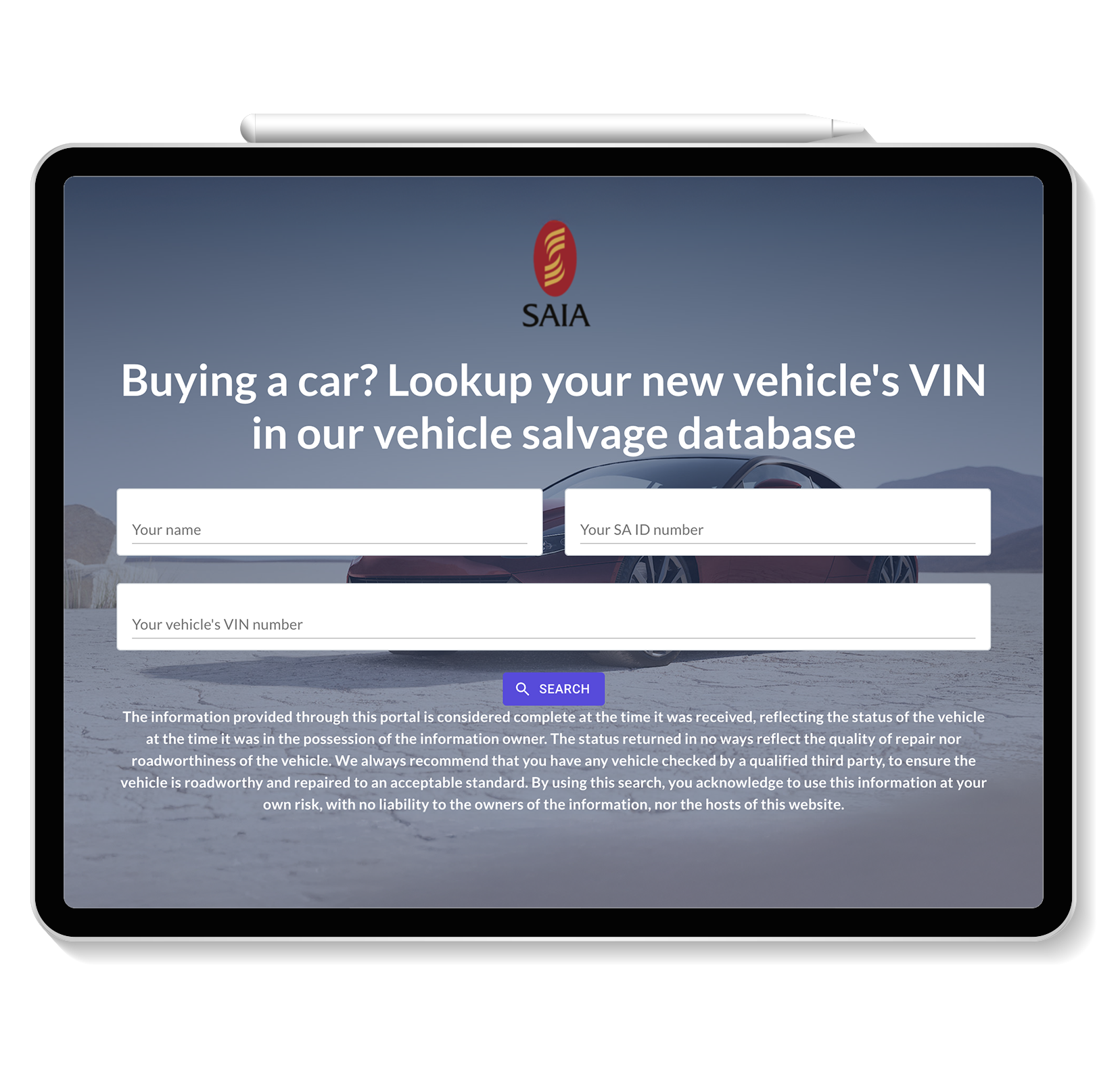
The South African Insurance Association launched a web-based platform designed to empower consumers with vital vehicle history information. Known as the Vehicle Identification Number (VIN) Lookup System, this free online tool enables users to verify the status of a vehicle by accessing data from the industry’s Vehicle Salvage Database (VSD).
What the VIN Lookup System Offers:
This easy-to-use system provides key information on vehicles that have undergone a status code change—a critical safety and transparency measure for consumers, insurers, and regulatory bodies alike.
The following categories are included:
- Rebuilt (Code 3): Vehicles that have sustained significant damage and have been rebuilt.
- Spare Parts Only (Code 3A): Vehicles that are no longer roadworthy and will be used for parts only.
- Scrap – Permanently Demolished (Code 4): Vehicles deemed permanently unfit for the road.
These records reflect vehicles that are either:
- Not permitted to operate on South African roads (Code 3A and Code 4), or
- Have changed their classification from Code 2 (Used) to Code 3 (Rebuild).
Access the system at www.vinlookupsa.co.za.
Non-Motor Insurance
SAIA is proactively engaged in several non-motor insurance initiatives, guided by contributions from SAIA members and the evolving challenges within the non-life insurance sector. One significant focus area is property insurance, which has become increasingly important due to the escalating number of risk factors threatening the sustainability of existing insurable risk classes.
Accordingly, it is imperative to identify and implement initiatives that establish the non-life insurance industry as a leader in risk management and proactive risk mitigation. These efforts are carried out in collaboration with key stakeholders, including municipalities.
Some of the key projects SAIA is currently involved in:
- Climate change workshops on an ad-hoc basis
- Fire Risks to Buildings (Structural Fires)
- Requirements set by the NRCS regarding energy-efficient geysers
- The National Treasury’s Sustainable Finance (Insurance) project
Property Protection
Fire and Localised Flooding Risk Management
The association continuously seeks to develop and implement fire prevention and management strategies aimed at mitigating potential losses resulting from fire and/or localised flooding, which are regarded as priority risk areas.
Accordingly, SAIA, through its strategic partnerships—such as with the Fire Protection Association of Southern Africa (FPASA)—collaborates with organisations established by the non-life insurance industry to deliver education on fire risk management to both the public and insurers. FPASA actively promotes best practices in fire risk management and represents SAIA at technical forums, including the South African Bureau of Standards (SABS) and the Engineering Council of South Africa (ECSA).
Furthermore, the association is a member of the National Disaster Management Committee and engages with various municipalities. It also provides limited fire risk management training to small municipalities at no cost.
SAIA maintains both formal and informal relationships with the following external entities:
Specialist Lines
The SAIA Forums are structured to address specialised business lines within the insurance sector. Their primary function is to respond to current challenges affecting the industry through the work of dedicated committees that concentrate on distinct specialised lines. SAIA supports these Forums by providing administrative and secretarial services, as well as guidance on stakeholder engagement and liaison with the authorities.
Current active SAIA Forums are:
- Agriculture Insurance Forum
- Association of Marine Underwriters of South Africa (AMUSA)
- Health Insurance Forum
- Premium Collections Forum
- Skills Development Forum (collaboration including Inseta; FIA; SAUMA and IISA)
- Fire Property Protection Liaison Forum (including FIA and SAUMA)
- South African Association of Engineering Insurers (SAAEI)
- Sasria Forum
Reinsurance
Reinsurance, often described as insurance for insurers, serves as a vital link between primary insurers and reinsurers, enabling the transfer of risks that surpass the insurers’ retention limits and capacity.
The Board Committee: Reinsurance is key in supporting SAIA’s mandate by offering strategic guidance on all reinsurance-related matters within the non-life insurance sector. Its focus spans regulatory developments, transformation initiatives, and emerging risks impacting reinsurers. The committee comprises Chief Executive Officers and Managing Directors from registered non-life reinsurance companies in South Africa that are members of SAIA.
South African Nuclear Pool
The South African Nuclear Pool is a specialised industry initiative designed to provide risk cover for nuclear installations in South Africa. Its administration and operations are managed through a structured framework comprising three key entities, detailed below.
South African Nuclear Pool Administrators (Pty) Ltd (SANPA)
South African Nuclear Pool Administrators (Pty) Ltd (SANPA) is appointed as the administrator of the Pool. It oversees day-to-day operations and provides administrative services on behalf of the South African Nuclear Pool. The company is remunerated through an administration fee for these services.
South African Pool for the Insurance of Nuclear Risks (SANP)
The South African Pool for the Insurance of Nuclear Risks (SANP) was established to insure the Koeberg Nuclear Power Station, owned by Eskom, and the Pelindaba research facility, owned by NECSA. Due to the limited capacity of the local insurance market to underwrite these risks, both facilities require support from the international pooling system.
The pool provides coverage for two categories of risk:
- Property Damage
- Third-Party Liability
The Insurance Data System (IDS)
The Insurance Data System is a data repository established to meet the data analytics needs of the industry by leveraging claims and policy data input into the system. Its primary purpose is to combat insurance crime, including mitigating or reducing syndicate activities related to vehicle cloning and fraudulent insurance claims.
Insurance Data System (IDS) Steering Committee
The Insurance Data System (IDS) consists of a Claims database and a Policy database, with the primary objective of combating fraud within the insurance industry. The operations of the IDS are overseen by a Steering Committee. Access to the system is restricted to SAIA members or their duly authorised intermediaries.